At one point, album releases were led by cover art reveals, consistent single releases, magazine covers, and late-night performances. Nowadays, fans are lucky to receive anything more than a release date.
Written by Earvin Adjei
Album rollouts are dead. Or at least, they’re on life support, with hip-hop possibly being the biggest casualty. Nowadays, many rappers find it increasingly difficult to generate excitement for their projects. Recent rollouts have been downright disastrous, leading to a loss of interest in these projects among fans.
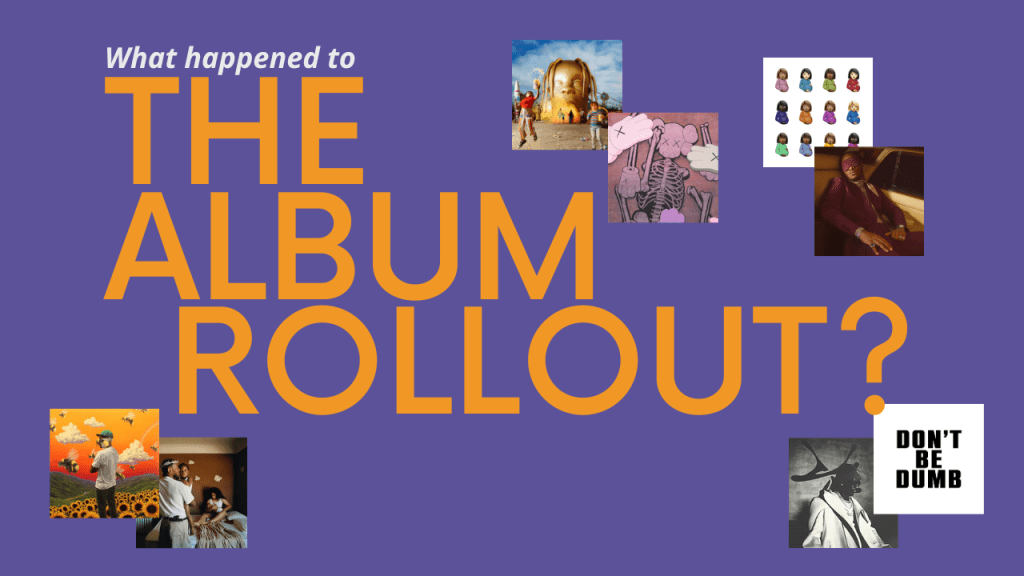
So, what does an effective album rollout look like? It often begins with a lead single, meant to cleanse the palate and give fans a taste of what’s to come. Then, the album announcement would follow, sometimes weeks or even months in advance. To keep anticipation high, artists might appear on radio shows, perform live, or drop visuals—all to create a moment. One artist who executed this to perfection was Tyler, the Creator. In late June and early July of 2017, Tyler began teasing something cryptic on Instagram. His feed became crowded with images of bees with speech bubbles, each one counting down. Every day, the number dropped, and fans began to speculate on what Tyler was teasing. On June 30, the countdown ended with a surprise double single release—“Who Dat Boy” featuring A$AP Rocky (which was accompanied by a music video) and “911 / Mr. Lonely” featuring Frank Ocean, Steve Lacy, and Anna of the North. A week later, Tyler revealed the album’s name, Flower Boy, alongside its artwork and official release date. Thanks to the singles, fans already knew what to expect sonically. The vibrant visuals also set the tone for what was to come. Tyler’s rollout relied on mystery, aesthetics, and consistency. The bee imagery became synonymous with that era. This wasn’t just an album rollout; it was world-building and an example of how things should be done.

So what changed? Why aren’t we seeing rollouts in hip-hop like Flower Boy anymore? The answer to that question is layered, but two factors loom the largest: streaming and social media. Streaming has been both a gift and a curse for music. On one hand, listeners now have unprecedented access to music across every genre and era. On the other hand, that access has led to oversaturation. With so much music available, listeners’ attention spans have shortened. Many now skim through albums, looking for tracks to add to their playlists instead of immersing themselves in the album listening experience. This shift has diminished the value of the album, and artists know it. Why invest time and resources in a rollout when singles are easier to promote and are far more likely to land on playlists curated by platforms like Spotify and Apple Music?
And as for the latter, social media has only intensified the shift. Long before the days of Instagram, Twitter, and TikTok, fans had far less access to the artists they listened to. But times have changed—artists now seem to be constantly in our faces. Fans feel closer than ever to them. This newfound closeness has erased the anticipation that once came with album releases. When an artist is always visible, the music can start to feel like an afterthought. Rollouts used to introduce us to a new era of an artist. Today, with artists sharing so much online, there’s no surprise left. Fans already feel like they’ve been along for the ride, which weakens the impact of a project. These effects are being showcased in real time. Some of the biggest names in hip-hop are announcing albums with little to no structure, and it shows. From questionable covers to forgettable singles, the rollout is quickly fading.
A$AP Rocky is currently spearheading one of the worst album rollouts that hip-hop has seen in quite some time. Rocky first began teasing his next album, “Don’t Be Dumb,” way back in December of 2022 during a live Amazon Music performance. Before the performance, Rocky could be heard confirming that the follow-up to 2018’s Testing was done. “Album finished. Don’t Be Dumb, let’s go!” he said. A Don’t Be Dumb backdrop that could be seen during his performance only helped to confirm that the project was soon to come. Fans instantly became hyped, as they would finally be getting a new project from the Harlem MC in over three years. But to this day, fans still don’t have the album, leaving everyone confused. Throughout 2023, Rocky teased the project with singles and hinted at a drop, but delayed it, citing sample clearances and leaks, an excuse fans were not buying. In June 2024, he took to Paris Fashion Week to announce an official release date of August 30. That summer, he what seemed to be a lead single with HIGHJACK. That single didn’t seem to mean much because when August arrived, the album didn’t. Fans were upset and confused, as they had been promised a set release date but were now left with a pushed-back release date for Fall, followed by early 2025. In the backdrop of all this, a legal battle for Rocky began in late January with a former member of the A$AP Mob. The trial stemmed from a 2021 incident where Rocky was accused of shooting at his former friend, A$AP Relli. Rocky had pleaded not guilty and faced up to 24 years in prison if convicted. This court case was seen as a potential hindrance to the album’s release, but you know what they say: “all publicity is good publicity.” Rocky’s name was being mentioned more than ever now, whether for good or bad reasons. His court dates were highly publicized as Rihanna and their children were in attendance, and he faced years in prison. The trial came to a screeching halt in February when Rocky was found not guilty. With all eyes on him and the best possible outcome from the trial, would he finally release the album? Nope. A Rolling Loud performance where he debuted several new tracks seemed like a reset button, and fans once again hoped the album was near. But nothing came from this. The project has remained in limbo despite more music trickling out, including “Pray4DaGang” in July. A rollout that once showed promise became disjointed and prolonged, making it harder for fans to care anymore. While Rocky’s tumultuous album rollout highlights the challenges faced by hip-hop artists, he is not the only one facing difficulties in building anticipation for their projects.
Similar to A$AP Rocky, Young Thug’s legal troubles derailed his musical output and momentum. His situation was far more severe, with the rapper spending over two and a half years behind bars. After his release in October, anticipation was sky-high for new music. But instead of dropping a “first-day-out” track — a move many rappers make to capitalize on post-prison buzz — Thug took to Twitter to throw cryptic shots at his former YSL artist, Gunna. Fans were disappointed, hoping he’d address the tension through music, not subtweets. Momentum briefly returned when Thug launched the official shop for UY SCUTI on April 16, revealing the cover art and announcing a May release date for his new album. He followed that up with his first post-prison interview, where he opened up about life after jail, the fractured relationship with Gunna, and the album. That same day, he dropped the album’s lead single, “Money on Money,” featuring Future, complete with a music video. Unfortunately, the track debuted at #39 on the Billboard Hot 100 and disappeared after just three weeks. The underwhelming performance seemed to deter Thug, and the album was pushed back to June, with Thug joking that it would drop “June 37.” Now, here we are in mid-July, and there’s still no album. What have we gotten instead? More cryptic tweets about Gunna. Not exactly the kind of rollout that inspires excitement. Another missed opportunity from a rapper that fans were anticipating music from. While Rocky and Thug have been examples of what not to do, there are some rappers who still get it right.
While many artists struggle to execute effective album rollouts, a handful still get it right. Tyler, the Creator — whose Flower Boy rollout was mentioned earlier — continues to deliver thoughtful rollouts. Most recently, the rollout for his Chromakopia album was short and sweet, culminating in a surprise Monday morning release — a nod to the early 2000s, when that timing was more common. Clipse also recently returned with their long-awaited comeback album, Let God Sort Em Out, backed by a traditional, well-paced rollout. They started with print media appearances and built momentum through interviews, culminating in a Tiny Desk concert and several high-profile radio spots. Both acts proved that with the right vision, the album rollout can still be done correctly.
Ultimately, the future of album rollouts in hip-hop remains uncertain, but one thing is clear: fans expect and deserve better. In an era dominated by social media and streaming, attention spans are shorter than ever. If artists continue to tease unfinished music and drop albums with last-minute announcements and lackluster singles, they shouldn’t expect fans to show up. These strategies don’t resonate with the audience and fail to generate anticipation. In an increasingly crowded market, artists must recognize the value of treating their music with intention. Cohesive storytelling, strategic release plans, and authentic engagement can go a long way in rebuilding the connection between artists and their audiences. For the sake of both the art and the listener, the rollout has to matter again.
 The Earvin Edit
Leave a comment